TWO:But if penal laws thus express the wide variability of human morality, they also contribute to make actions moral or immoral according to the penalties by which they enforce or prevent them. For not[74] only does whatever is immoral tend to become penal, but anything can be made immoral by being first made penal; and hence indifferent actions often remain immoral long after they have ceased to be actually punishable. Thus the Jews made Sabbath-breaking equally immoral with homicide or adultery, by affixing to each of them the same capital penalty; and the former offence, though it no longer forms part of any criminal code, has still as much moral force against it as many an offence directly punishable by the law.This infamous crucible of truth is a still-existing monument of that primitive and savage legal system, which called trials by fire and boiling water, or the accidental decisions of combat, judgments of God, as if the rings of the eternal chain in the control of the First Cause must at every moment be disarranged and put out for the petty institutions of mankind. The only difference between torture and the trial by fire and water is, that the result of the former seems to depend on the will of the accused, and that of the other two on a fact which is purely physical and extrinsic to the sufferer; but the difference is only apparent, not real. The avowal of truth under tortures and agonies is as little free as was in those times the prevention without fraud of the usual effects of fire and boiling water. Every act of our will is ever proportioned to the force of the sensible impression which causes it, and the sensibility of every man is limited. Hence the impression produced by pain may be so intense as to occupy a man¡¯s entire sensibility and leave him no other liberty than the choice of the shortest way of escape, for the present moment, from his penalty. Under such circumstances the answer of the accused is as[151] inevitable as the impressions produced by fire and water; and the innocent man who is sensitive will declare himself guilty, when by so doing he hopes to bring his agonies to an end. All the difference between guilt and innocence is lost by virtue of the very means which they profess to employ for its discovery.
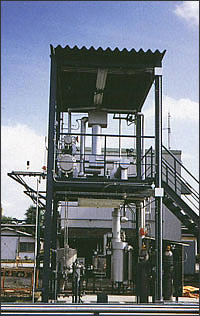
Great attention is recently being paid to global environmental issues, and it is now conceivable that companies will need to treat used solvents themselves. In consideration of this kind of social issue, we have developed a “membrane separation type solvent dehydration system,” which uses a polyimide membrane with superior dehydration properties developed by Ube Industries, Ltd. in combination with our own distillation and concentration technology that has resulted in solvents being more easily recovered.
THREE:
- 1Under the distillation system, even in case of azeotropic solvent compositions, this system which remove water vapor by the polyimide membrane will easily dehydrate.
- 2In comparison with the distillation system, it significantly saves on use of steam.
- 3Dehydration can be performed through merely supplying evaporated vapor to the membrane module and maintaining the differential pressure between the permeable side and the impermeable side.
- 4Solvent purity of 99.9% or more can be achieved by carrying out dehydration with a polyimide membrane only.
- 5The polyimide membrane has superior heat and solvent resistance. Therefore, the vapor permeation system reduces contamination of the membrane and thus extends its life.
THREE:
The aromatic polyimide membrane is highly permeable to water vapor but less permeable to vapors of organic compounds such as alcohol etc.
THREE:The following is the kind of reasoning adopted[175] by the thief or the assassin, whose only motives for not breaking the laws are the gallows or the wheel. (I know that the analysis of one¡¯s own thoughts is an art only learnt by education, but a thief does not the less act according to certain principles because he is unable to express them). ¡®Of what sort,¡¯ he argues, ¡®are these laws that I am bound to observe, that leave so great an interval between myself and the rich man? He denies me the penny I ask of him, and excuses himself by ordering from me a work of which he himself knows nothing. Who has made these laws? Were they not made by rich and powerful men, who have never deigned to visit the wretched hovels of the poor, who have never divided a musty loaf of bread amid the innocent cries of famished children and the tears of a wife? Let us break these bonds, which are fatal to the greater number, and only useful to a few indolent tyrants; let us attack injustice in its source. I will return to my state of natural independence; I will live for some time happy and free on the fruits of my courage and address; and if the day should ever come when I have to suffer and repent for it, the time of suffering will be short, and I shall have one day of misery for many years of liberty and pleasure. As the king of a small band, I will correct the errors of fortune, and see these tyrants pale and tremble before one, whom in their insolent arrogance they rated lower than their[176] horses or their dogs.¡¯ Then religion hovers before the mind of the criminal, who turns everything to a bad use, and offering him a facile repentance and an almost certain eternity of bliss does much to diminish in his eyes the horror of that last tragedy of all.
- 1 Recovery of the detergent solvent Recovery of the cleaning solvent such as electronic parts industry, precision instrument industry.
- 2Solvent recovery and the refinement Solvent recovery and the refinement such as chemical industry, an industry of medical supplies, food industry, the fermentation industry.
THREE: The reason for translating afresh Beccaria¡¯s ¡®Dei Delitti e delle Pene¡¯ (¡®Crimes and Punishments¡¯) is, that it is a classical work of its kind, and that the interest which belongs to it is still far from being merely historical.That Penology is still only in its experimental stage as a science, in spite of the progress it has made in recent times, is clear from the changes that are so constantly being made in every department of our penal system. We no longer mutilate nor kill our criminals, as our ancestors did in the plenitude of their wisdom; we have ceased to transport them, and our only study now is to teach them useful trades and laborious industry. Yet whether we shall better bring them to love labour by compulsory idleness or by compulsory work, whether short imprisonment or long is the most effective discipline, whether seclusion or association is least likely to demoralise them, these and similar questions have their answers in a quicksand of uncertainty. This only may experience be said to have yet definitely proved, that very little relation exists in any country between the given quantity of crime and the quantity or severity of punishment directed to its prevention. It has taken thousands of years to establish this truth, and even yet it is but partially recognised over the world.
Acetone, ethanol, methyl ethyl ketone, butanol, isopropyl alcohol, ethyl acetate, methyl isobutyl ketone, others (including hexane and toluene).
